INITIAL INFORMATION

Technology is the making, modification, usage, and knowledge of tools, machines, techniques, crafts, systems, methods of organization, in order to solve a problem, improve a preexisting solution to a problem, achieve a goal or perform a specific function. It can also refer to the collection of such tools, machinery, modifications, arrangements and procedures. Technologies significantly affect human as well as other animal species' ability to control and adapt to their natural environments. The word technology comes from Greek τεχνολογία (technología); from τέχνη (téchnē), meaning "art, skill, craft", and -λογία (-logía), meaning "study of-". The term can either be applied generally or to specific areas: examples include construction technology, medical technology, and information technology.
The human species' use of technology began with the conversion of natural resources into simple tools. The prehistorical discovery of the ability to control fire increased the available sources of food and the invention of the wheel helped humans in travelling in and controlling their environment. Recent technological developments, including the printing press, the telephone, and the Internet, have lessened physical barriers to communication and allowed humans to interact freely on a global scale. However, not all technology has been used for peaceful purposes; the development of weapons of ever-increasing destructive power has progressed throughout history, from clubs to nuclear weapons.
Technology has affected society and its surroundings in a number of ways. In many societies, technology has helped develop more advanced economies (including today's global economy) and has allowed the rise of a leisure class. Many technological processes produce unwanted by-products, known as pollution, and deplete natural resources, to the detriment of the Earth and its environment. Various implementations of technology influence the values of a society and new technology often raises new ethical questions. Examples include the rise of the notion of efficiency in terms of human productivity, a term originally applied only to machines, and the challenge of traditional norms.
Philosophical debates have arisen over the present and future use of technology in society, with disagreements over whether technology improves the human condition or worsens it.Neo-Luddism, anarcho-primitivism, and similar movements criticise the pervasiveness of technology in the modern world, opining that it harms the environment and alienates people; proponents of ideologies such as trans humanism and techno-progressivism view continued technological progress as beneficial to society and the human condition. Indeed, until recently, it was believed that the development of technology was restricted only to human beings, but recent scientific studies indicate that other primates and certain dolphin communities have developed simple tools and learned to pass their knowledge to other generations.
Science, engineering and technology
The distinction between science, engineering and technology is not always clear. Science is the reasoned investigation or study of phenomena, aimed at discovering enduring principles among elements of the phenomenal world by employing formal techniques such as the scientific method. Technologies are not usually exclusively products of science, because they have to satisfy requirements such as utility, usability and safety.
Engineering is the goal-oriented process of designing and making tools and systems to exploit natural phenomena for practical human means, often (but not always) using results and techniques from science. The development of technology may draw upon many fields of knowledge, including scientific, engineering, mathematical, linguistic, and historical knowledge, to achieve some practical result.
Technology is often a consequence of science and engineering — although technology as a human activity precedes the two fields. For example, science might study the flow of electrons in electrical conductors, by using already-existing tools and knowledge. This new-found knowledge may then be used by engineers to create new tools and machines, such as semiconductors, computers, and other forms of advanced technology. In this sense, scientists and engineers may both be considered technologists; the three fields are often considered as one for the purposes of research and reference.
The exact relations between science and technology in particular have been debated by scientists, historians, and policymakers in the late 20th century, in part because the debate can inform the funding of basic and applied science. In the immediate wake of World War II, for example, in the United States it was widely considered that technology was simply "applied science" and that to fund basic science was to reap technological results in due time. An articulation of this philosophy could be found explicitly in Vannevar Bush's treatise on postwar science policy, Science—The Endless Frontier: "New products, new industries, and more jobs require continuous additions to knowledge of the laws of nature... This essential new knowledge can be obtained only through basic scientific research." In the late-1960s, however, this view came under direct attack, leading towards initiatives to fund science for specific tasks (initiatives resisted by the scientific community). The issue remains contentious—though most analysts resist the model that technology simply is a result of scientific research.
HISTORY
Paleolithic ( 2.5 million - 10,000BC )

The use of tools by early humans was partly a process of discovery, partly of evolution. Early humans evolved from a species of foraging hominids which were already bipedal, with a brain mass approximately one third that of modern humans. Tool use remained relatively unchanged for most of early human history, but approximately 50,000 years ago, a complex set of behaviors and tool use emerged, believed by many archaeologists to be connected to the emergence of fully modern language.
-Stone Tools

Human ancestors have been using stone and other tools since long before the emergence of Homo sapiens approximately 200,000 years ago.[20] The earliest methods of stone tool making, known as the Oldowan "industry", date back to at least 2.3 million years ago,[21] with the earliest direct evidence of tool usage found in Ethiopia within the Great Rift Valley, dating back to 2.5 million years ago.[22] This era of stone tool use is called the Paleolithic, or "Old stone age", and spans all of human history up to the development of agriculture approximately 12,000 years ago.
To make a stone tool, a "core" of hard stone with specific flaking properties (such as flint) was struck with a hammerstone. This flaking produced a sharp edge on the core stone as well as on the flakes, either of which could be used as tools, primarily in the form of choppers or scrapers.These tools greatly aided the early humans in their hunter-gatherer lifestyle to perform a variety of tasks including butchering carcasses (and breaking bones to get at the marrow); chopping wood; cracking open nuts; skinning an animal for its hide; and even forming other tools out of softer materials such as bone and wood.
The earliest stone tools were crude, being little more than a fractured rock. In the Acheulian era, beginning approximately 1.65 million years ago, methods of working these stone into specific shapes, such as hand axes emerged. The Middle Paleolithic, approximately 300,000 years ago, saw the introduction of the prepared-core technique, where multiple blades could be rapidly formed from a single core stone. The Upper Paleolithic, beginning approximately 40,000 years ago, saw the introduction of pressure flaking, where a wood, bone, or antler punch could be used to shape a stone very finely.
-Fire
The discovery and utilization of fire, a simple energy source with many profound uses, was a turning point in the technological evolution of humankind. The exact date of its discovery is not known; evidence of burnt animal bones at the Cradle of Humankind suggests that the domestication of fire occurred before 1,000,000 BC;[27] scholarly consensus indicates that Homo erectus had controlled fire by between 500,000 BC and 400,000 BC. Fire, fueled with wood and charcoal, allowed early humans to cook their food to increase its digestibility, improving its nutrient value and broadening the number of foods that could be eaten.
-Clothing and shelter
The discovery and utilization of fire, a simple energy source with many profound uses, was a turning point in the technological evolution of humankind. The exact date of its discovery is not known; evidence of burnt animal bones at the Cradle of Humankind suggests that the domestication of fire occurred before 1,000,000 BC; scholarly consensus indicates that Homo erectus had controlled fire by between 500,000 BC and 400,000 BC. Fire, fueled with wood and charcoal, allowed early humans to cook their food to increase its digestibility, improving its nutrient value and broadening the number of foods that could be eaten.
Neolithic throught classical antiquity ( 10,000 BC - 300 AD )
Man's technological ascent began in earnest in what is known as the Neolithic period ("New stone age"). The invention of polished stone axes was a major advance because it allowed forest clearance on a large scale to create farms. The discovery of agriculture allowed for the feeding of larger populations, and the transition to a sedentist lifestyle increased the number of children that could be simultaneously raised, as young children no longer needed to be carried, as was the case with the nomadic lifestyle. Additionally, children could contribute labor to the raising of crops more readily than they could to the hunter-gatherer lifestyle.
With this increase in population and availability of labor came an increase in labor specialization. What triggered the progression from early Neolithic villages to the first cities, such as Uruk, and the first civilizations, such as Sumer, is not specifically known; however, the emergence of increasingly hierarchical social structures, the specialization of labor, trade and war amongst adjacent cultures, and the need for collective action to overcome environmental challenges, such as the building of dikes and reservoirs, are all thought to have played a role.
-Metal Tools
Continuing improvements led to the furnace and bellows and provided the ability to smelt and forge native metals (naturally occurring in relatively pure form). Gold, copper, silver, and lead, were such early metals. The advantages of copper tools over stone, bone, and wooden tools were quickly apparent to early humans, and native copper was probably used from near the beginning of Neolithic times (about 8000 BC). Native copper does not naturally occur in large amounts, but copper ores are quite common and some of them produce metal easily when burned in wood or charcoal fires. Eventually, the working of metals led to the discovery of alloys such as bronze and brass (about 4000 BC). The first uses of iron alloys such as steel dates to around 1400 BC.
-Energy and Transport
Meanwhile, humans were learning to harness other forms of energy. The earliest known use of wind power is the sailboat. The earliest record of a ship under sail is shown on an Egyptian pot dating back to 3200 BC. From prehistoric times, Egyptians probably used the power of the Nile annual floods to irrigate their lands, gradually learning to regulate much of it through purposely built irrigation channels and 'catch' basins. Similarly, the early peoples of Mesopotamia, the Sumerians, learned to use the Tigris and Euphrates rivers for much the same purposes. But more extensive use of wind and water (and even human) power required another invention.
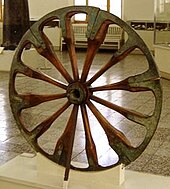
According to archaeologists, the wheel was invented around 4000 B.C. probably independently and nearly-simultaneously in Mesopotamia (in present-day Iraq), the Northern Caucasus (Maykop culture) and Central Europe. Estimates on when this may have occurred range from 5500 to 3000 B.C., with most experts putting it closer to 4000 B.C. The oldest artifacts with drawings that depict wheeled carts date from about 3000 B.C.; however, the wheel may have been in use for millennia before these drawings were made. There is also evidence from the same period of time that wheels were used for the production of pottery. (Note that the original potter's wheel was probably not a wheel, but rather an irregularly shaped slab of flat wood with a small hollowed or pierced area near the center and mounted on a peg driven into the earth. It would have been rotated by repeated tugs by the potter or his assistant.) More recently, the oldest-known wooden wheel in the world was found in the Ljubljana marshes of Slovenia.
The invention of the wheel revolutionized activities as disparate as transportation, war, and the production of pottery (for which it may have been first used). It didn't take long to discover that wheeled wagons could be used to carry heavy loads and fast (rotary) potters' wheels enabled early mass production of pottery. But it was the use of the wheel as a transformer of energy (through water wheels, windmills, and even treadmills) that revolutionized the application of nonhuman power sources.
Mediaeval and Modern History ( 300 AD - Now )
Innovations continued through the Middle Ages with innovations such as silk, the horse collar and horseshoes in the first few hundred years after the fall of the Roman Empire. Medieval technology saw the use of simple machines (such as the lever, the screw, and the pulley) being combined to form more complicated tools, such as the wheelbarrow, windmills and clocks. The Renaissance brought forth many of these innovations, including the printing press (which facilitated the greater communication of knowledge), and technology became increasingly associated with science, beginning a cycle of mutual advancement. The advancements in technology in this era allowed a more steady supply of food, followed by the wider availability of consumer goods.
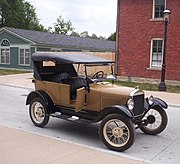
Starting in the United Kingdom in the 18th century, the Industrial Revolution was a period of great technological discovery, particularly in the areas of agriculture, manufacturing, mining, metallurgy and transport, driven by the discovery of steam power. Technology later took another step with the harnessing of electricity to create such innovations as the electric motor, light bulb and countless others. Scientific advancement and the discovery of new concepts later allowed for powered flight, and advancements in medicine, chemistry, physics and engineering. The rise in technology has led to the construction of skyscrapers and large cities whose inhabitants rely on automobiles or other powered transit for transportation. Communication was also greatly improved with the invention of the telegraph, telephone, radio and television. The late 19th and early 20th centuries saw a revolution in transportation with the invention of the steam-powered ship, train, airplane, and automobile.
 The 20th century brought a host of innovations. In physics, the discovery of nuclear fission has led to both nuclear weapons and nuclear power. Computers were also invented and later miniaturized utilizing transistors and integrated circuits. The technology behind got called information technology, and these advancements subsequently led to the creation of the Internet, which ushered in the current Information Age. Humans have also been able to explore space with satellites (later used for telecommunication) and in manned missions going all the way to the moon. In medicine, this era brought innovations such as open-heart surgery and later stem cell therapy along with new medications and treatments. Complex manufacturing and construction techniques and organizations are needed to construct and maintain these new technologies, and entire industries have arisen to support and develop succeeding generations of increasingly more complex tools. Modern technology increasingly relies on training and education — their designers, builders, maintainers, and users often require sophisticated general and specific training. Moreover, these technologies have become so complex that entire fields have been created to support them, including engineering, medicine, and computer science, and other fields have been made more complex, such as construction, transportation and architecture.
No hay comentarios:
Publicar un comentario